
William Drozdowski has high cholesterol and high blood pressure and takes medications to control these conditions so he sees his cardiologist, Holy Name's Dr. Jaffar Raza, twice a year. Since William also has a family history of cardiac issues, Dr Raza decided to give William a stress test, in 2018, to have a baseline. The results of the stress test came back abnormal and Dr. Raza recommended William, now in his 60s, have an angiogram to look for any narrowing or blockages in the arteries.
During an angiogram, a catheter is threaded through the blood vessels to the coronary arteries to visualize the inside of the coronary arteries, which supply blood to the heart muscle. Thankfully, William's angiogram showed that he didn't have any major blockages.
6 years later, William had a blood test and his A1C test to measure the amount of sugar in his blood over the last three months was elevated–and he was shocked to learn he was at pre-diabetic levels. It became crucial for Bill to have his coronary circulation assessed, due to his risk factors.
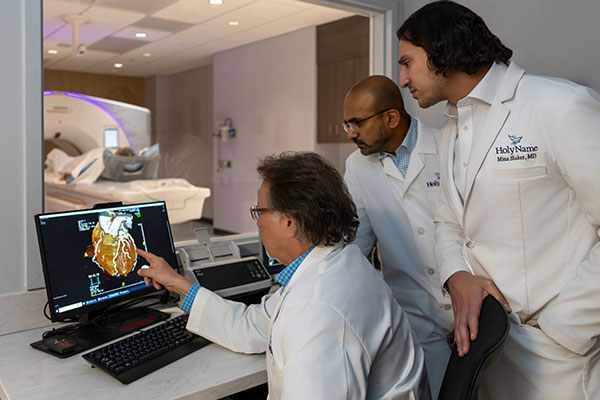
Dr. Raza thought that William would be an excellent candidate for a study being conducted at Holy Name using a new noninvasive imaging tool called a coronary computed tomography angiography (CCTA) scan. The CCTA scan Dr. Raza ordered uses photon-counting imagery to give doctors a clearer view of a patient's heart, without the need for a catheter. Holy Name is one of only two hospitals in New Jersey that uses this advanced scan for cardiac imaging.
"We chose Photon Counting CCTA because it gives us much clearer pictures of the heart with less radiation and less contrast dye," says Dr. Raza. "That means we can spot problems more accurately and make better decisions about care—while keeping the procedure safer and more comfortable for patients."
"It was a seamless procedure," Willaim said.
Williams CCTA scan once again showed that his arteries are clear, without any concerning blockages or narrowing, but this time he did not need to undergo the potential discomfort that comes with an angiogram. Unless he experiences any more cardiac episodes or has an abnormal stress test, he'll have his next CCTA scan in five years as part of the study.
