
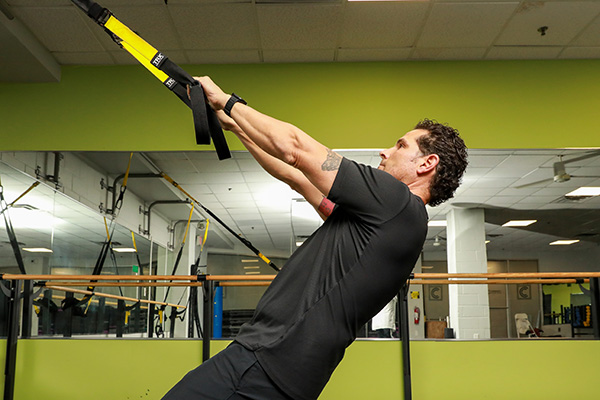
Staying active wasn’t optional for Westwood resident and former firefighter Baron Ballester — it was who he was. His identity had been shaped by a 26-year career in the fire service, years of playing competitive sports, as well as an Ironman and nearly 20 half Ironmans under his belt. Even now, at 52, he continues to challenge himself as an NCAA football official, sprinting up and down the field each weekend.
But in February 2025, everything changed.
“I got off a plane and suddenly felt like a 90-year-old man walking through the airport,” he recalled. What he had written off as normal discomfort from the flight or from sleeping on an old mattress quickly escalated into something he couldn’t ignore. Severe back pain left him barely able to walk, and he soon developed neuropathy in his right foot. By late April, he couldn’t get out of bed for nearly 36 hours.
An MRI revealed the cause: bulging discs on the left side of his L4 and L5 vertebrae, and bone-on-bone deterioration on the right. As the pain spread and numbness worsened, he knew he needed relief.
Baron had taken his kids to Holy Name's orthopaedic specialists in the past, so he trusted their expertise. That led him to spine surgeon Dr. Teja Karukonda. After learning more about his condition and his active lifestyle, Dr. Karukonda recommended robotic fusion surgery. Baron was eager to put the pain behind him once and for all.
“When he explained that a disc replacement might mean another surgery down the line—and that the fusion would be permanent—I was sold,” he said.
Baron had surgery in May 2025. The robotic-assisted procedure lasted about two hours. He stayed one night in the hospital as a precaution and by the next morning, he was walking nearly a mile. Two days after surgery he walked more than a mile at the mall.
Within three weeks, Baron was lifting light weights. While carefully sticking to instructions he received from Dr. Karukonda and his Holy Name physical therapist, he soon progressed to lifting weights just over 10 pounds. Baron continued physical therapy for about 12 weeks, gradually tapering as he regained strength. At 10½ weeks post-surgery, he completed his first run: 2.5 miles at a slow pace. A week later, he was comfortably running almost three miles again.
By week 12, Dr. Karukonda cleared him for all activities, placing his rapid progress in the top one to two percent of recovery speeds.
Six-and-a-half months after surgery, Baron says he feels “fantastic.” He’s playing pickleball one to two times a week and is back on the field officiating college football, traveling across the country and sprinting during games without pain. He’s even planning his first triathlon in over 2 years, aiming to compete in 2026.
Looking back, he credits both the advanced technology and the people at Holy Name for his experience. “The care team was excellent— just absolutely fantastic,” he said.
Now pain-free and fully active, he’s grateful to have his life — and his lifestyle — back.
