
If you've ever dealt with achy, swollen, or heavy legs, or noticed the unmistakable bulge of varicose veins, you’d be among as many as 40 million Americans who live with varicose veins. When left untreated, the condition can cause skin changes, inflammation, painful ulcers, and other serious complications.
The good news is that effective, minimally invasive treatments exist, and most can be done on an outpatient basis with little to no downtime. The challenge is knowing where to turn. A number of independent, freestanding vein clinics have opened across the region, focused on rapid procedures that may not include a full evaluation of a patient's vascular health. As a result, more patients end up needing second opinions, treatment guidance, and help managing complications.
A Comprehensive Approach, Under One Roof
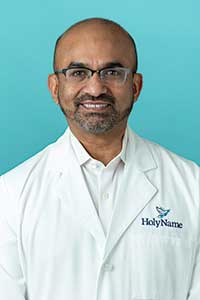
At Holy Name, our approach to vascular care is multi-disciplinary, led by interventional cardiologist Jaffar Raza, MD and a team of specialists in interventional cardiology, vascular surgery, and wound care as one team. That matters because venous disease rarely shows up in isolation; a patient with varicose veins may also have underlying issues, a non-healing wound, or peripheral arterial disease. A program built around a single procedure isn't always positioned to see or treat the whole picture.
Many times, varicose or spider veins are purely superficial, and your desire to eliminate them may be cosmetic rather than medical. But having an expert rule out any deep underlying medical concerns will provide peace of mind in the long run.
"Whether a patient is seeking treatment for a venous condition or cosmetic concerns, our specialists can provide efficient, personalized care and achieve the best possible outcome for every patient," says Dr. Raza.
What Everyone Should Know When Choosing Where to Go
Our experts frequently correct misdiagnoses and treatment from other clinics. One common issue is confusion between venous reflux and deep vein thrombosis (DVT). These are different conditions requiring different tests: Reflux is best evaluated with a venous duplex ultrasound that maps how blood flows through the veins over time, while the venous duplex for DVT looks for a clot. This distinction can get blurred and patients may not be thoroughly evaluated for both.
Patients seeking a second opinion at Vein Health at Holy Name frequently share their frustration with having paid for outside tests that don't provide a full picture of their venous health. In some cases, that second opinion reveals a missed diagnosis or realization of an unnecessary procedure performed.
Getting an Accurate Diagnosis First
Vein Health at Holy Name’s approach starts with a detailed history and physical exam, followed by a venous duplex ultrasound to identify exactly where and why veins aren't functioning properly. This diagnostic-first approach helps ensure patients aren't rushed into a procedure that treats a symptom without addressing the root cause — especially important for those whose prior treatment didn't resolve their symptoms.
What's Treated and How
Vein Health at Holy Name evaluates and manages a number of vascular conditions, including:
- chronic vein insufficiency
- varicose veins
- venous ulcers
- deep vein thrombosis (DVT)
Once a clear diagnosis is established, treatment options include:
- endovenous ablation, which uses heat energy delivered through a thin catheter to close off a diseased vein
- venaseal, specialized medical adhesive to permanently seal diseased veins
- sclerotherapy, FDA approved medication that irritates the lining of the vein and closes it
- wound care management for venous ulcers that need specialized healing support
"Venous disease can significantly affect a person's health, comfort, and mobility, yet many patients are unaware that effective treatments are available and that procedures can often be performed on an outpatient basis with little downtime," Dr. Raza says.
For patients already treated elsewhere but still dealing with symptoms, complications, or even unresolved insurance authorization issues, the Vein Health at Holy Name offers a thorough re-evaluation and honest guidance about next steps, with the full resources of a hospital behind it should they be necessary.
Venous disease is common, but it isn't something to leave to chance, or something you have to live with. If you're experiencing leg swelling, aching, visible varicose veins, or a wound that isn't healing, or you simply want a second opinion, Vein Health at Holy Name offers an accurate, comprehensive path forward.
To learn more or schedule a consultation, contact Dr. Raza at (551) 242-2555 or book an appointment online.
